The Yellow Throat
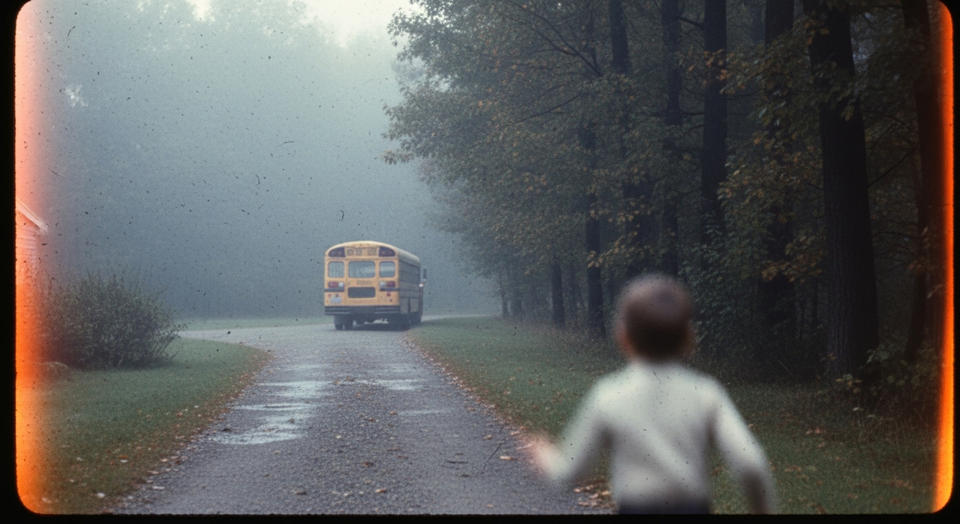
The bus was the color of something manufactured to be noticed, a yellow that existed nowhere in nature, not in egg yolks or autumn leaves or anything that grew, but only on machines built to collect children. It sat at the bottom of the driveway with its door folded open, engine running in that thick diesel way that made the air taste like a parking garage. The driver's arm was draped over the steering wheel. A woman whose name I have forgotten but whose forearm I remember — heavy and pale, resting there with a patience that seemed hostile. My mother's hand was on my back. Between the shoulder blades. I could feel each of her fingers separately through the cotton of my shirt, and it was that pressure, not hard, not painful, just the inevitability of the next minute already decided, that made me run.
I didn't decide to run. That's the thing I've turned over for thirty years and still can't get past. My legs fired. The gravel sprayed under my sneakers and I was off the driveway and across the yard and the air hit my face cold and wet — it must have rained during the night because the grass soaked through my shoes instantly — and I heard my mother make a sound behind me. Not words yet. A sound. The sound a hand makes when what it's pressing on is suddenly gone.
Then I was in the trees.
The woods behind our house were not deep. I know this now. A narrow band of oak and birch and evergreen that separated our property from the Hendersons', maybe two hundred yards before it opened onto their back field. But when you are seven or eight, and I cannot remember exactly how old I was, which bothers me, which seems like the kind of thing you should know, when you are that height and moving that fast, the woods are endless. The trunks multiply. The light drops away. The ground turns soft and your feet sink into years of dead leaves and you are somewhere else entirely.
I ran deeper. My breath was coming in sharp little gasps that I could hear outside my own head, as though some other, smaller animal were running alongside me. Branches whipped across my forearms. A spiderweb hit my face — the way it clung to my forehead and eyelashes like something alive trying to hold me — and I wiped at it with both hands without slowing down.
Behind me, my mother's voice.
"You get back here. You get back here right now."
Nothing uncertain about it. The words were hard and flat and meant exactly what they said. My mother was not wondering why I had run. She was not concerned with what I was afraid of, what the bus meant to me, what happened on it or inside me when I climbed its steps. She needed me on that bus. That was the entire problem, the whole of it, and if she could just get her hands on me and march me back down the driveway and put me on, then everything would be fine. The morning would be fixed. The day could proceed. Whatever was wrong with me could be dealt with later, or not at all, as long as I was on the bus.
I ran harder.
Annie Dillard writes about being chased through the streets of Pittsburgh as a child, how the pursuit became pure elation, the body so alive it forgot to be afraid. I didn't have that. Or I did, but it was tangled so tightly with terror that I couldn't separate them then and can't now. The joy of my legs working, of air in my chest, of the woods opening ahead of me. And the terror of my mother's breathing getting closer. She was faster than I expected. Or I was slower. The sounds she made as she ran were the sounds of someone solving a problem, closing a distance, doing the one thing the morning required of her.
I could hear her feet in the leaves. The shush-shush of it. Her breathing, ragged now, high in her throat. Then her fingers were on me.
She caught my shirt. The back of it, at the collar, and the fabric pulled tight across my throat for a half second before I twisted free. I heard the sound of a seam letting go — material failing — and then I was loose again and running, and my mother was behind me with the torn piece still in her hand, or maybe still reaching. I didn't look back.
She stopped. I don't know when. At some point the sound of her pursuit fell away and it was just me and my own breathing and the woods.
I slowed to a walk. My hands were shaking. My shirt hung loose and torn at the back where her fingers had been, and the cool air touched the skin there. That small patch of exposed back. The morning air on it.
I stopped near a birch tree whose bark was peeling in long papery strips, white and pale orange. I put my hand on it. The bark was cool and slightly damp. I could feel my heart in my ears, in my fingertips against the trunk. A bird, just one, making a sound at precise intervals somewhere above me.
My mother would be walking back to the house. The bus would have left. There would be consequences: a phone call to the school, my father told when he got home, the silence at dinner that meant something had been decided about me in my absence. I knew all of this. I could feel the rest of the day gathering at the edges of the trees, waiting for me to step back out.
But I didn't step out. Not yet.
I stood with my hand on the birch tree and my torn shirt and the bird making its sound. The light came through the canopy thin and gray-white, the way early morning light does when it has to work through branches. The leaves under my feet were dark and wet. My sneakers were soaked through. I was cold.
I was free.
Somewhere behind me, through the trees, my mother was calling the school to say I wouldn't be coming in today, and her voice on the phone would be calm and managed and nothing like the voice that had chased me through the woods. Later she would come to the back door and call my name, not shouting this time, just calling, and I would hear it, and I would wait, and eventually I would walk back.
But not yet.
The air smelled like wet bark and cold dirt and the damp musty sweetness of rotted wood and leaves, the smell of things going back into the ground. My hand was still on the birch. The morning was happening without me in it. The bus was on its route, picking up the other children, and they were climbing the steps one by one and taking their seats, and somewhere in a classroom a teacher was calling roll and my name was in her mouth and no one answered, and my desk sat empty with the chair pushed in, and the morning moved on as mornings do, ordinary and intact, and I was not in it. I was here, in the woods, a boy with a torn shirt and soaked shoes standing still in the one place no one had planned for me to be.
I stayed.