The Text Written in Flesh
There is a scene early in Solenoid where the narrator pulls a thread from his navel. Centimeter by centimeter, his body unravels — the organic becoming textile, the self becoming spool. It is disgusting and transfixing and, in the logic of Mircea Cărtărescu's universe, perfectly reasonable. Of course the body is a spool. Of course it can be unwound. The only question is what you'll find at the center: another body, or the absence of one, or something that was never a body at all but a map to somewhere the body couldn't go.
This is what Solenoid does for 660 pages. It unwinds you.
I read this book over the course of a summer and into fall, and the thing I keep circling back to — the thing I still can't articulate cleanly — is that I could never figure out what it was. Not in a confused way. In the way of something that keeps rearranging itself every time you look directly at it. I'd settle into a rhythm, thinking okay, this is an autofictional novel about a failed writer in Bucharest, and then I'd be inside the body of a scabies mite, witnessing a microscopic crucifixion. I'd think I was reading a philosophical diary, and then the narrator's house would levitate. The book resists categorization not as a gimmick but as a principle. It is a novel the way Bucharest is a city: technically accurate, but the word doesn't cover half of what's actually happening inside.
The premise, to the extent there is one, turns on a single counterfactual. In life, Mircea Cărtărescu read a poem at a literary circle in 1970s Bucharest and was praised. His career as Romania's most important living writer followed from that evening. In Solenoid, the narrator reads the same poem and is demolished. The criticism breaks something in him. He never writes again, not professionally, not publicly. He becomes a schoolteacher in a decaying district of the city, living in a ship-shaped house with a solenoid buried in its foundation, filling notebooks that no one will read.
This is the last thing I'll say about the plot.
What matters is the paradox that drives the whole book: a man who rejects literature produces 660 pages of the most extravagantly literary prose you're likely to encounter in any language. He insists he is not a writer. He insists his notebooks are not a novel. And yet here the novel is, dense and teeming and wildly alive, built from the ruins of a career that never happened. Kafka asked Max Brod to burn his manuscripts, and Brod, ambivalently, probably as Kafka half-expected, refused. Cărtărescu's narrator doesn't ask anyone. He lets the manuscript burn along with his body and his mind. He saves the child, not the masterpiece. The professional writer, the narrator tells us, will always save the masterpiece. The dilettante saves the child.
And then the dilettante writes something no professional could have written. Because the rejection of literature doesn't produce silence. It produces a different kind of text, one written in flesh instead of ink, in a body instead of on a page.
This is where Solenoid becomes unlike anything else I've read. The novel is obsessively corporeal. Lice appear in the opening pages. Dental horror unfolds across multiple sections with a specificity that will make you run your tongue across your own teeth. Scabies, parasites, the architecture of fingernails. Cărtărescu writes the body with the kind of granular precision most novelists reserve for landscapes or cities. The body is his landscape. It is his city.
You might reach for Cronenberg here, and the comparison isn't wrong: the flesh-machine textures, the sense of the body as something that can be opened and entered and explored. But Cronenberg's body horror works through invasion. The body in Videodrome or The Fly is horrifying because something foreign is getting in, whether technology, mutation, or the new flesh. Cărtărescu inverts this completely. The body in Solenoid is horrifying because something infinite is already inside it and we can't access it. The body isn't being invaded. It's a locked room. A room in a labyrinth we carry around but can't navigate. When the narrator enters the body of a scabies mite and becomes, in that microscopic world, a kind of messiah, a mite-Christ, the effect isn't surrealist spectacle. It's a shift in what the novel is proposing about scale, about consciousness, about what a body contains. The mite city is a city. It has its own architecture, its own suffering, its own theology. And it exists in a crease of human skin.
I read those passages and had to put the book down. Not wonder exactly, and not horror. Something closer to vertigo: the realization that the difference between the microscopic and the cosmic might be an illusion, and your body is the proof.
But the body alone doesn't account for the book. Bucharest does.
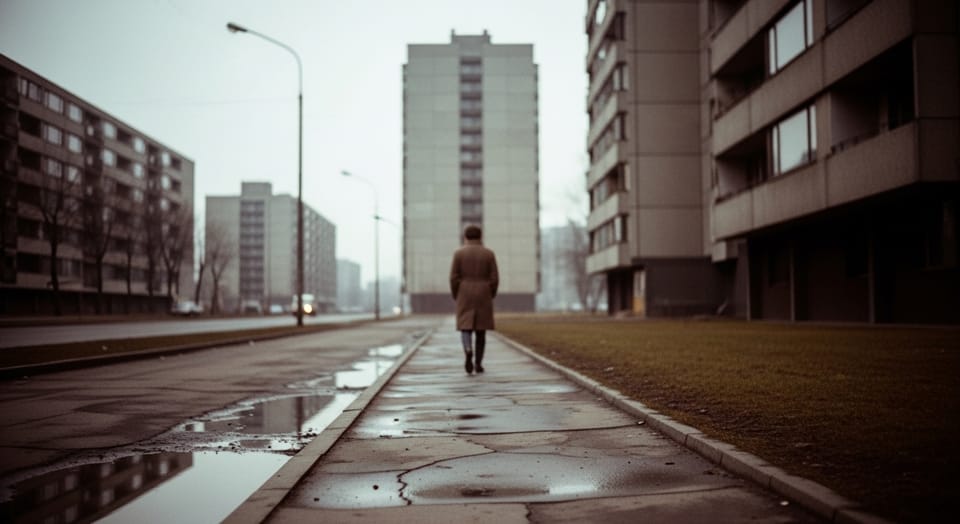
Cărtărescu's Bucharest is not a setting. It is the novel's other protagonist, maybe its primary one. The narrator calls it "the saddest city on the face of the earth, but at the same time, the only true one." Reading this over several months, I started to feel the weather of the book settling into my own days: dank, overcast, perpetually gray, a sky that seems to press down on the concrete. Even in the surreal passages, even when houses are levitating and dimensions are folding, the specificity of the city never breaks. You can feel the cracked plaster, the recycling quotas, the particular despair of a Romanian school in the Ceaușescu era. It's what makes the surrealism land, not because it contrasts with realism but because it grows directly out of it, the way mold grows out of damp.
Everyone who writes about Solenoid mentions Kafka's Prague. The comparison is obvious enough to be useless. The better comparison, the one that actually unlocks something, is Tarkovsky's Stalker. In that film, the Zone is a place apart. You travel to it. It's cordoned off, forbidden, dangerous to reach. Inside the Zone, the laws of physics bend, rooms grant wishes, the architecture of the world responds to your inner state. The Zone is where transcendence lives, and you have to make a pilgrimage to get there.
Cărtărescu's Bucharest is the Zone inverted. You don't travel to it. You're already in it. The solenoids, electromagnetic devices buried in the foundations of certain buildings, don't transport you somewhere else. They reveal that somewhere else was always here, underneath the plaster, beneath the floorboards, inside the walls. You don't need a Stalker to guide you. You need the solenoids to show you what you've been living on top of. This is the more destabilizing proposition. Tarkovsky's characters can leave the Zone. Cărtărescu's narrator can never leave Bucharest. Not because he's trapped, but because Bucharest is reality, and reality is the Zone, and there is nowhere else to go that isn't also this.
Bruno Schulz built a city like this once, in The Street of Crocodiles. His Drohobycz is a city of perpetual becoming: matter transforms, wax figures gain sentience, seasons become moods, the father becomes a bird. Everything is in motion. Cărtărescu does something different. His Bucharest doesn't transform. It was built already in ruin, exists in permanent decay, and the change happens not to the city but to the person looking at it. Schulz's surrealism is transformation. Cărtărescu's is revelation. The city doesn't change. You learn to see what was always there.
The Brooklyn Rail review gets at something important when it invokes Pasolini: "an ugliness that, just as in Pasolini, is an open door to the sacred." Tudor Arghezi, the great interwar Romanian poet, built an ars poetica out of turning mud and boils into beauty. Cărtărescu inherits that tradition and radicalizes it. The solenoid is Arghezi's alchemical principle given a physical form and buried in the architecture of the city. The ugliness isn't transcended. It is the site of transcendence. It is the only site of transcendence. Beauty that starts beautiful has nowhere to go.
Here is the other thing no one has adequately reckoned with: the scale.
Solenoid moves from lice to the cosmos and back within the span of a few pages. A fingernail becomes a dome, dome-shaped, like a planetarium. A mite becomes a world. A city becomes a body. A body becomes a map of the universe. This constant shifting isn't surrealist play, though it has the texture of it. It's closer to a form of prayer. Or meditation. Or whatever word you want for the practice of looking at something until it stops being what you thought it was and starts being everything else.
Borges did something adjacent to this: the Aleph, the point that contains all points, the garden of forking paths. Cărtărescu is clearly a devotee; the house-as-infinite-library, the counterfactual architecture, the map that becomes the territory are Borgesian structures. But Borges built his labyrinths from ideas. They are intellectual constructions, cool and crystalline, admired from outside even when you're nominally inside them. You read Borges from a library chair, and the infinity you encounter is a concept.
Cărtărescu's labyrinth is made of flesh. The infinity you encounter is your own intestines, your own dental nerves, the mite-cities living in your skin. You don't admire it. You feel it in your gut. If Borges compressed infinity into a story of five pages to prove that infinity can be compressed, Cărtărescu expands a single body across 660 pages to prove that it can't. The LARB review opens with Borges's famous complaint about vast books, his argument that anything worth saying can be said briefly. Solenoid is the counter-argument. It proves that you cannot say in five minutes what takes 660 pages, because the experience of being lost is the meaning. You have to be inside the labyrinth long enough to forget there's an outside.
Bolaño did something similar with 2666, another maximalist novel about a city that contains hidden worlds. But Bolaño's maximalism is centrifugal. It expands outward through multiple perspectives, continents, decades. Cărtărescu's spirals inward through a single consciousness. 2666 accumulates horror through forensic repetition. Solenoid accumulates something harder to name. Call it wonder, call it dread, call it the feeling you get when you stare at a patch of skin under a magnifying glass long enough for it to become alien. Bolaño's city hides death. Cărtărescu's hides transcendence.
I finished Solenoid in October and spent the next several weeks not reading anything else. Not because I was recovering from it, exactly. More because I didn't trust other books to do what this one had done. Which is an unreasonable response, and I know it. But unreasonable responses are what Cărtărescu traffics in.
The narrator, this failed writer, this schoolteacher in a gray district of the saddest city on earth, lives more intensely than any successful novelist in contemporary fiction. This is the paradox that sits at the center of the book and never resolves. His existence is pathetic by any external measure. He is a nobody. He marks homework. He rides a tram through streets that look like they were designed by a depressed God. And yet every page vibrates with the attention of someone who is almost painfully alive to the world. The notebooks he fills are not literature. They are something literature doesn't have a category for.
There is a thought experiment at the heart of Solenoid: save the child or save the manuscript. The narrator chose the child. He chose the body, the city, the gray sky, the lice, the mites, the cracked plaster, the notebooks nobody reads. He chose all of it over the career, over the page, over the museum of literature.
And then he wrote the text that the museum can't contain.
I don't know what that makes Solenoid. Its narrator insists it's an anti-novel. An anti-book by an anti-author. Fine. Call it what you want. I know what it did to me: it made me look at my own hands, the dome of each fingernail, the lines in my palms, the mites I now know live in the creases, and wonder what text was written there that I'd been too literate to read.
Sean Cotter's translation, which won both the LA Times Book Prize and the Dublin Literary Award, deserves its own paragraph. Not as a courtesy but as an acknowledgment. The English prose glides from sentence to sentence without calling attention to itself. That's the hardest kind of translation to pull off: the kind where you forget you're reading a translation until you remember that what you're reading was impossible in any single language to begin with. Cotter doesn't anglicize Cărtărescu's Bucharest. He lets it remain foreign while making it breathable. The dream logic holds in English. The sentences land.
Solenoid was published in Romanian in 2015. It arrived in English in 2022 thanks to Deep Vellum and Will Evans, the publisher who had the nerve to commission a 660-page translation of an "untranslatable" Romanian novel during a pandemic. That it exists in English at all is its own kind of solenoid: a buried device that, once activated, reveals something about the landscape that was always there but couldn't be seen.
Read it. Or don't. But know that it's down there, humming under the floorboards, whether you look or not.