Burned by the Moon
The grass was wet and I could feel it through my jeans where I sat against the brick. Upstairs, the light was on. It was a yellow light, the kind that suggests a warmth I was no longer allowed to claim.
But I should go back.
My window faced hers. That was the arrangement. I could see her front door from where I sat at my desk, and I told myself this was coincidence, though I had noticed it on the first day and said nothing. The street was residential, settled. Not students. People in their twenties and thirties who worked in the town, who had chosen to stay in a place most people passed through. The houses were close together, brick and wood siding, narrow alleys of grass between them that no one maintained. In summer the windows stayed open. You could hear someone's television. You could hear a glass set down on a table. You could hear, if you were quiet enough and the night was still enough, the particular rhythm of a conversation you were not part of.
I had been reading. Or I had been holding a book open, which is not the same thing. The light was on in my room and the light was on in hers and I was aware of both facts the way you are aware of a sound you've been hearing for so long it has become part of the room. Then I saw the car.
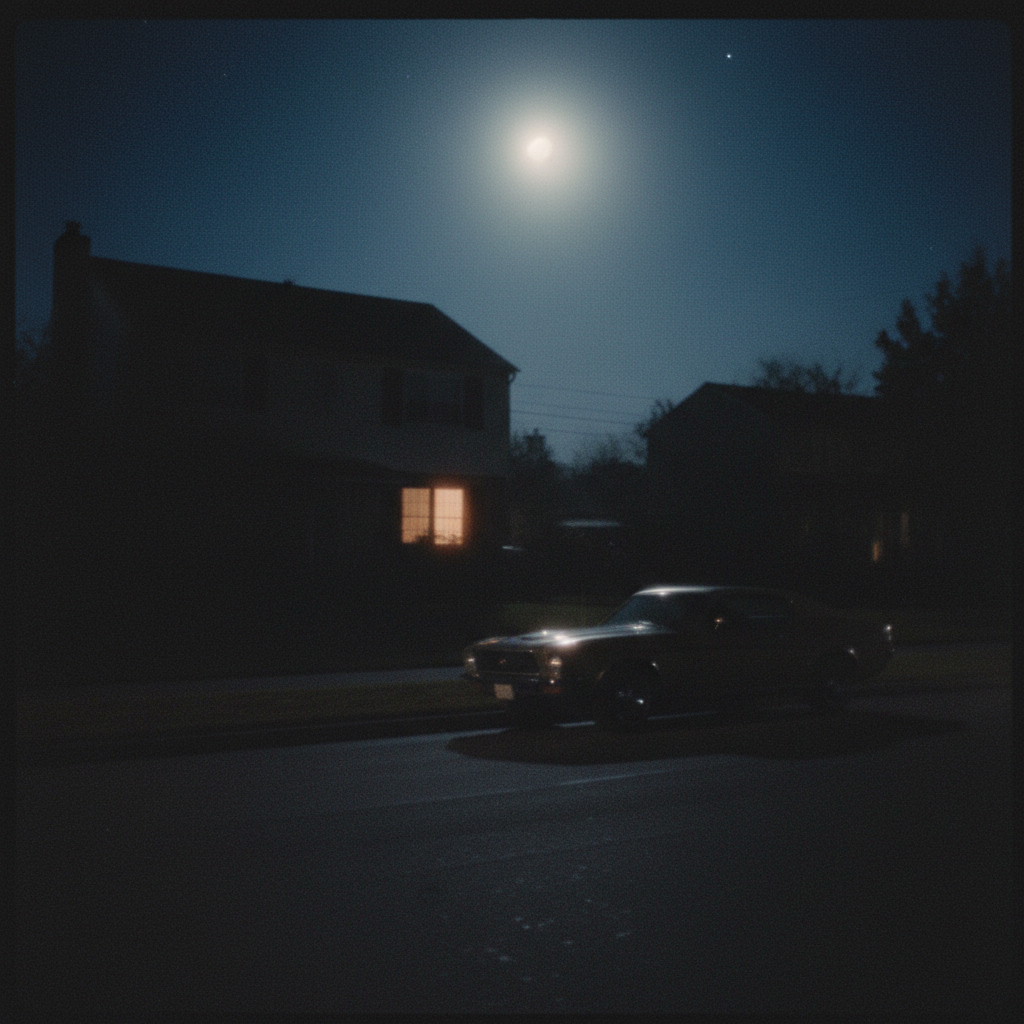
I knew the car. I hadn't known I knew it until I saw it parked in front of her house, and something in me identified it the way you identify a word in a foreign language — not fluently, not with confidence, but with a recognition that arrives before understanding. A hatchback, dark-coloured, with a dent in the rear panel I had seen in a parking lot somewhere, at a show, outside the bar where people from the scene gathered on weeknights. His car. I could not yet say his name in my head but the car was enough. The car was already the whole sentence.
I sat at my window for a while. I don't know how long. The street was empty. A moth circled the porch light of the house two doors down. I turned off my lamp and sat in the dark and watched the yellow rectangle of her window and then I stood up and put on my shoes.
The laces. I remember the laces. The way my hands performed this ordinary task while the rest of me was somewhere else entirely, already across the street, already pressing against the wooden fence. I tied them carefully. I stood. I opened my front door and the summer air hit my face and it was warm and damp and smelled of cut grass and the faintly mineral smell that mountains give off at night when the rock is cooling.
I crossed the street. There was no traffic. There was never traffic on that street after ten. My shoes on the asphalt made a sound and then I was on the grass and the sound stopped and I moved along the side of her house to the narrow strip between the wall and the fence. The space was not meant for a person. It was leftover space, a margin, the architectural equivalent of an afterthought. The brick was cool against my back. The fence pressed into my shoulder. I could feel a nail head through my shirt.
The window was open above me. Two storeys up, cracked wide because it was July and the air did not move unless you let it through.
I heard her laugh first. Not a full laugh... a half-breath, the kind that lives in the throat. Then his voice. I knew the register immediately. We had talked about music, about the local scene, about bands that played the smaller rooms. An acquaintance. The specific category of person you recognise by timbre before you can recall by name. His voice was low and unhurried and it carried the ease of someone who was exactly where he wanted to be.
Then a pause that was not a pause. A silence that had texture. The difference between two people not speaking and two people choosing not to speak... I could hear it. I could hear the room rearranging itself around a new gravity.
A murmur. Hers. Softer now, stripped of the performative register she used in conversation. This was the voice underneath the voice. I had heard it. I had been the one it was directed at, once.
Then the sound of kissing and the small involuntary sounds that follow it and I pressed my back harder into the brick and closed my eyes and my imagination supplied what my ears could not fully render. The creak of a floorboard under shifting weight. The bed frame. The specific frequency of breathing when breathing has stopped being automatic. I could see it without seeing it... the room I knew, the bed I knew, the angles of light from that yellow lamp falling across skin that was no longer mine to see.
I was shaking. Not from cold.
I had not been faithful. She had not been faithful. We had made each other wretched in the slow methodical way that people do when they are too young to leave and too stubborn to fix what they have broken. I had no right to this feeling. I had no clean claim on betrayal. And still the sound continued above me and still I pressed into the brick and felt each second take something away... a piece of the story I had told myself about who I was, about who we were, dismantled with each breath I heard that was not mine.
The body moved before I gave it permission. Not a decision. An expulsion. I peeled off the wall and walked back across the grass and crossed the street and opened my door and sat down in the dark in the chair that faced her window.
The car was still there. The light was still on. I sat and I looked at it. The yellow rectangle, the dark shape of the hatchback beneath the trees. This was the view now. This was what I would see when I looked out. The car still there. The light still on. And me in the dark, knowing exactly what that light contained, waiting for it to go out, understanding already that it would not go out for me.